



Guest posting used to be one of the easiest ways to explain link building: write an article, get it published on another website, add a backlink, and move on.
In 2026, that formula is far less reliable. Guest posting itself has not disappeared, but the easy version of guest posting has become much harder to justify.
Google still uses links as part of its search systems, including link analysis and PageRank. At the same time, Google’s spam policies specifically identify paid links intended to manipulate rankings, low-value content created for links, and certain third-party publishing arrangements as problems.
That leaves you with a more useful question than “Does guest posting work?”
The question is:
Is this particular guest post worth publishing, paying for, or pursuing?
That answer depends on the publication, the audience, the article, the link arrangement, and what happens after publication.
What Is Guest Posting in 2026?
Guest posting means creating an article that appears on another website rather than your own.
A genuine guest contribution can serve several purposes at once:
- Introduce your ideas to a new audience
- Establish your name or company in a specific subject area
- Generate referral traffic
- Build relationships with editors and publishers
- Earn legitimate editorial exposure
- Give readers a useful resource or supporting reference
- Potentially earn a backlink when the publisher allows one
The backlink is only one part of the value. But sometimes SEOs (search engine optimizers) make this one the #1 thing.
That distinction matters because Google’s current guidance does not say that all third-party content is spam. Its site reputation policy specifically says third-party content by itself is not a violation. Google’s examples of content that can remain acceptable include editorial columns, opinion pieces, other editorial work, and third-party content intended to reach readers rather than manipulate search rankings.
A guest article can fit into that legitimate category.
A mass-produced article published primarily because another domain has stronger ranking signals is a different situation and counts as spam.
So, Is Guest Posting Worth It in 2026?
Yes, guest posting can still be worth it, but the value comes from the quality of the placement rather than the mere existence of a backlink.
Google’s ranking systems still use link analysis and PageRank. Google also says links help its systems understand what pages are about and discover pages to crawl.
That does not mean every backlink helps equally for the rankings.
Imagine two placements.
The first is a carefully edited article on a publication that regularly covers your industry. The readers are the same people you want to reach. The article contains original research and one naturally useful reference to your website that’s much needed for the topic.
The second is a $200 placement on a site publishing dozens of unrelated articles about software, gambling, finance, health, pets and business. The article exists because someone wanted a link, and the same commercial pages appear across dozens of similar domains.
Both technically contain a backlink.
They are not equivalent opportunities.
The second model is precisely where Google’s spam policies become relevant and can be a problem for your overall SEO campaign.
Google’s Position on Guest Posts Has Become Much More Specific
A common mistake is to treat Google’s old warnings about guest blogging as a blanket statement that guest posts are forbidden.
The current guidance is more precise.
Google defines link spam as creating links primarily to manipulate search rankings. Its examples include buying or selling links for ranking purposes, exchanging money or goods for links, excessive link exchanges, and paid articles or guest posts containing links that pass ranking credit or use optimized anchor text for manipulation.
At the same time, Google explicitly says buying and selling links can be part of normal advertising and sponsorship activity when those links are properly qualified with rel="sponsored" or rel="nofollow".
That creates an important distinction here:
| Guest-post model | What is happening | How to think about it in 2026 |
|---|---|---|
| Editorial guest contribution | You provide useful original content to a relevant publication under its editorial standards | Potentially legitimate and useful for audience, reputation, referral traffic and exposure |
| Sponsored article | A business pays for publication as advertising or promotion | Can be legitimate advertising, but paid links should be qualified with rel="sponsored" or rel="nofollow" |
| Link-first guest-post campaign | Money, content and placements are organized mainly to manufacture ranking signals at scale | Falls directly into the type of activity Google’s link-spam and site-reputation policies are designed to address |
The practical lesson is simple:
Do not confuse publishing content with buying ranking signals.
Google’s September 2026 Spam Update
This one counts for anyone evaluating guest posting right now.
Google released its September 2026 spam update on September 24, 2026, saying the rollout applies globally and across all languages and may take up to two weeks. Google’s Search Status Dashboard lists the update among its 2026 ranking incidents.
That update does not mean every website using guest posts is being punished.
It does mean that publishers and advertisers should be much less comfortable with strategies built around questionable links, low-value pages or large-scale content designed primarily for search manipulation.
Google’s spam systems are designed to detect and neutralize manipulative practices. Google also states that spam updates can cause sites violating its policies to rank lower or disappear from results.
For a business spending money on guest posts, this changes the financial calculation.
A placement that only has value if Google counts its backlink is fragile.
A placement that attracts customers, builds recognition, reaches a relevant readership and still makes sense without SEO credit has several ways to produce a return.
The Biggest Problem With Guest Posting in 2026 Is Not Guest Posting
It is the guest-post marketplace.
There are thousands of websites advertising guest-post opportunities. Many look impressive from a distance because they show a Domain Rating, Domain Authority, traffic figure or a list of categories.
Those numbers can hide the real situation.
BuzzStream analyzed 257,267 websites with complete pricing and SEO data from a major link marketplace for its 2026 guest-post study. It found 96.2% classified as low quality under its own traffic and Domain Rating framework. About 78% received fewer than 1,000 estimated organic visits per month, and only 1.37% qualified as high-quality or top-tier under the study’s thresholds.
Those figures should not be interpreted as saying 96.2% of every guest post on the internet is bad.
They describe a particular marketplace dataset, using third-party metrics and the researcher’s own quality thresholds.
The finding is still useful.
A large guest-post inventory does not mean a large supply of valuable publications.
That is why choosing a website by DR or DA alone is a weak SEO strategy.
Why DA and DR Can Mislead You
Domain Authority and Domain Rating are third-party metrics.
Google does not publish a Google “DA” or “DR” score that determines whether a website should rank. Google itself advises people to evaluate third-party SEO tools critically and says those tools do not have access to Google’s internal ranking data.
That does not make third-party metrics useless.
They can help you compare websites, see the value, traffic estimates, backlinks, historical charts, and more.
They just should not become the entire decision.
A website with DR 70 and almost no real audience may be a worse publishing opportunity than a smaller industry publication with genuine readers, strong editorial standards and highly relevant coverage.
Traffic, topic relevance, readership, publishing history and editorial quality tell you more about why the placement exists.
What Makes a Guest Post Worth Your Time?
Start with the reader.
Ask one question:
Would this article still be useful if the backlink disappeared?
That question eliminates a surprising number of bad opportunities.
A worthwhile guest contribution usually has several characteristics:
The Publication Has a Real Audience
Look beyond estimated SEO traffic.
Check whether people actually read and share the site’s work.
Look at:
- Recent article engagement
- Newsletter presence
- Social activity
- Recognizable writers
- Returning coverage of the same subject
- Search visibility for important industry topics
- Comments or community activity where relevant
- Evidence that businesses or professionals actually know the publication
An audience that matches your business can be more valuable than a much larger general audience.
The Website Is Topically Relevant
Relevance matters.
Google’s link documentation says descriptive anchor text and surrounding context help people and Google understand linked content. Google also warns against stuffing keywords into links.
Suppose you operate a cybersecurity company.
A detailed article on a cybersecurity publication about ransomware recovery makes sense.
A random article on a general entertainment blog linking to your cybersecurity service page is much harder to justify from a reader’s perspective, even if it’s on a high-DR and high-traffic website.
You want the link to make sense because the reader needs it, not because an SEO spreadsheet needs another referring domain.
The Publication Has Editorial Standards
Look at five to ten recent articles and evaluate:
- Are they researched?
- Are sources used properly?
- Do articles have identifiable authors?
- Does the site edit submissions?
- Are headlines and formatting consistent?
- Does the site reject obvious advertising content?
- Does it publish original reporting?
A publication that clearly cares about what goes live gives your contribution more context and credibility.
Google’s current site reputation guidance even considers how third-party content is presented, its quality, authorship, whether it appears elsewhere in near-identical form, and whether it looks integrated with the host publication.
The News-Site Problem Is Bigger Than It Looks
News and media websites deserve extra scrutiny because the label “news” can create the impression of authority.
BuzzStream’s 2026 marketplace analysis identified nearly 39,400 news and media sites in its dataset. The research found roughly 91% of the news sites with complete metrics fell into its low-quality classification. Only 4.2% qualified as high quality or top tier under its framework.
Again, those numbers describe the one marketplace sample, not the entire news industry.
The lesson is more useful than the statistic:
A news logo, news category or news-style homepage does not prove that a website has a real news audience.
Before paying for a “news publication” placement, investigate the site’s readership, journalism history, indexing, editorial ownership, content quality and outbound-link behavior.
The Link Is Not the Product
This is one of the biggest mindset changes for 2026.
A backlink should be treated as one component of a publication opportunity.
The real value can come from:
Audience + credibility + referral traffic + brand exposure + relationships + useful content + potential SEO value
That is much stronger than:
One backlink
The difference becomes obvious when a publisher changes the link to nofollow.
A link marked nofollow is not simply worthless. Google treats nofollow, sponsored and ugc attributes as hints rather than absolute commands for ranking systems. Such links can still put your brand in front of readers and generate direct traffic.
If you would immediately cancel a placement because the publisher uses nofollow, ask yourself whether you were buying an audience or buying a ranking signal.
What About Paid Guest Posts?
This is where marketers often get confused.
Paying for advertising is not the same thing as paying for an artificial ranking signal.
Google’s current spam documentation says paid links used for advertising and sponsorship are acceptable when appropriately marked with rel="sponsored" or rel="nofollow". Google’s preferred attribute for paid placements is rel="sponsored".
That gives publishers a straightforward structure.
A paid article can function as advertising.
The commercial relationship should not be disguised as an organic editorial endorsement for the purpose of passing ranking credit.
For a sponsored article, a publisher might use:
<a rel="sponsored" href="https://example.com">
  Learn more
</a>
nofollow remains an acceptable alternative.
The problem is the arrangement where the buyer says:
“I am paying you specifically because I want a ranking link, I want this exact anchor text, and I want the link to pass ranking credit.”
That is much closer to the activity Google describes as link spam.
Exact-Match Anchor Text Is Still a Major Warning Sign
Imagine someone selling a guest post asks for this exact anchor:
best affordable enterprise cybersecurity software
Then imagine that the same buyer places 30 articles across different sites using slightly different versions of the same keyword.
That pattern becomes difficult to describe as normal editorial linking.
Google’s link guidance recommends descriptive and reasonably concise anchor text and specifically advises against forcing keywords into anchor text.
Natural links can use:
- Your brand name
- Your company name
- A page title
- A natural descriptive phrase
- A URL
- A sentence-level reference
You should not need to engineer every word around a target keyword.
Can Guest Posts Help SEO Without Passing Link Equity?
Yes, but the benefits are different.
A relevant guest article can expose your brand to new readers.
Readers may click through.
They may search for your brand later.
They may mention your company elsewhere.
A publisher may invite you back.
An editor may introduce you to another publication.
The article itself may attract backlinks.
Your name may become associated with a topic.
These effects do not require every guest-post link to pass ranking credit.
Semrush’s 2025 guidance makes a similar point, describing guest posting as a way to reach new audiences and build brand authority, with referral traffic and branded search activity as possible outcomes.
What About AI Search in 2026?
Guest posting now sits alongside a larger shift in how people find information.
Google has expanded search experiences around generative AI and multimodal search. In September 2026, Google added multimodal search reporting in Search Console for queries involving Google Lens, Circle to Search, image uploads and other visual search experiences.
Industry SEO platforms increasingly frame third-party mentions and backlinks as part of broader brand visibility across search and AI systems. Semrush, for example, now describes backlinks and external coverage as signals that can contribute to how brands are understood across traditional and AI-mediated search.
That does not mean a guest post guarantees inclusion in ChatGPT, Google AI Overviews, Gemini or Perplexity.
There is no such guaranteed formula.
The more defensible approach is to build real external evidence about your brand.
A detailed article on a respected publication can contribute to that external presence.
A network of nearly identical paid articles on obscure sites does much less to establish a credible identity.
Google Does Not Ban Third-Party Content
This point deserves its own section because it is often misunderstood.
Google’s site reputation policy says third-party content alone does not violate the policy.
Google explicitly lists columns, opinion pieces and editorial work among examples that are not considered inconsistent with the policy. It also says third-party advertorial or native advertising can be acceptable when its purpose is to share content directly with readers rather than manipulate rankings.
That means a publication does not need to eliminate every external contributor.
It needs editorial control.
The host publication should decide:
- What topics fit
- Whether the article is useful
- Whether claims are supported
- Whether the writer is credible
- Whether the article belongs on the site
- How commercial relationships are disclosed
- Which links are appropriate
- How paid links are qualified
The bigger risk appears when a website becomes a container for third-party pages that exist mainly because the website has accumulated ranking signals.
Google describes exactly that type of behavior in its site reputation policy.
How to Evaluate a Guest Post Opportunity Before Saying Yes
Use this process before writing, buying or accepting a placement.
1. Check the Audience
Ask whether the site’s readers are potential customers, industry professionals, researchers, journalists or people who genuinely care about your subject.
If the answer is no, stop there.
2. Check Topic Relevance
Look at the site’s last 50 or so articles.
Do they regularly cover your subject?
Does your proposed topic fit naturally?
Would the editor have accepted the topic without the backlink?
Those questions expose weak opportunities quickly.
3. Check Organic Visibility
Look at estimated organic traffic and search visibility.
Do not use one tool as absolute truth.
Use third-party data as evidence, then manually inspect the site.
Google itself warns that third-party SEO tools do not possess its internal ranking data.
4. Check the Content Quality
Read actual articles.
Look for original reporting, research, examples, screenshots, expert commentary, useful explanations and proper editing.
A website filled with 500-word generic posts is telling you something.
5. Check Publishing Frequency
If a site publishes an enormous stream of guest articles every day across unrelated industries, investigate carefully.
Volume alone does not prove a violation.
A strange combination of high publishing volume, unrelated subjects, weak editing, aggressive commercial links and low readership is a much stronger warning sign.
6. Check Outbound Links
Look at recent articles.
Are links used as references?
Or does nearly every article contain commercial anchor text pointing to unrelated businesses?
The second pattern deserves caution.
7. Check Who Controls the Article
Find out whether the publisher reviews, edits and owns the editorial decision.
A real publication behaves like a publication.
A link marketplace often behaves like a transaction.
8. Check the Commercial Arrangement
Know exactly what you are paying for.
Is it advertising?
Content production?
Editorial sponsorship?
A contribution?
A link?
These are not the same thing.
For paid links, Google recommends rel="sponsored" and accepts rel="nofollow".
9. Check Whether the Article Is Unique
Never send the same article to a collection of websites with minor changes.
Google’s spam policies identify republishing, automated transformations and large amounts of unoriginal content created for ranking manipulation as problematic.
10. Check the Opportunity Without SEO
This is the strongest filter.
Ask:
Would I still want this publication if Google completely ignored the link?
When the answer is yes, you are usually evaluating an actual media opportunity rather than a commodity backlink.
What Guest Posting Strategies Should You Avoid in 2026?
Some tactics should set off immediate warning signals.
Buying Hundreds of Guest Posts
Scale is not automatically a violation.
The problem is building a system where the primary objective is manufacturing ranking signals.
A campaign can become difficult to defend when content quality, relevance and editorial selection become secondary to link volume.
Publishing on Any Site That Accepts You
Acceptance is not proof of quality.
Some websites accept almost anything because the site itself exists mainly to sell placements.
Repeating the Same Article
Near-duplicate publishing across many domains produces little value for readers and can create a suspicious link pattern.
Forcing Exact-Match Anchors
You should not need a rigid anchor-text spreadsheet dictating exact keywords for every article.
Natural linking is much easier to explain editorially.
Choosing Websites Only by DR or DA
High third-party metrics do not automatically mean a site reaches the right audience.
Use metrics as filters, not as the final decision.
Assuming Every Paid Post Is an Editorial Endorsement
A paid article should be handled as a commercial arrangement when that is what it is.
Google’s current guidance gives publishers a way to qualify paid links appropriately.
Using AI to Produce Guest Posts at Scale
Google does not prohibit AI simply because AI was used.
Google’s guidance says generative AI can be useful for research and structure, but producing many pages without adding value for users can fall under scaled content abuse. The policy applies regardless of whether the content was generated by automation, humans or a combination of methods.
The sensible use of AI is assistance.
The dangerous model is volume without editorial value.
How Much Should You Spend on a Guest Post?
There is no universal price that makes a guest post good.
A $100 placement can be more useful than a $1,000 placement if the first publication has the right audience and the second one has no readership.
BuzzStream’s 2026 marketplace study found an average vendor price of $461 and an estimated direct-from-site average of $295 across its analyzed dataset. The same research found that higher-quality inventory was much rarer than low-quality inventory.
Treat those numbers as market research rather than a pricing rule.
The better calculation is:
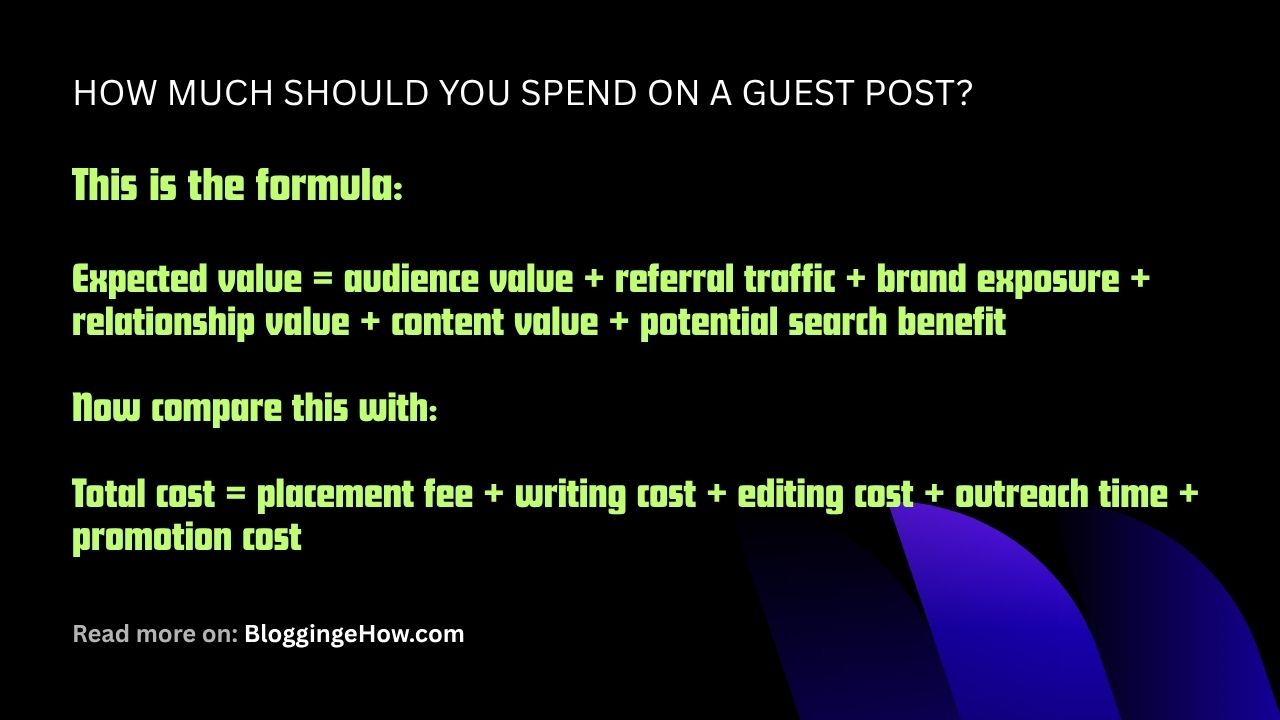
Expected value = audience value + referral traffic + brand exposure + relationship value + content value + potential search benefit
Then compare that with:
Total cost = placement fee + writing cost + editing cost + outreach time + promotion cost
A $500 article that produces relevant leads can make more business sense than ten $50 placements that nobody reads.
How to Measure Whether a Guest Post Worked
Do not stop at “the link is live.”
Track what happened after publication.
Referral Traffic
Use analytics to see whether readers clicked from the guest article.
Traffic volume matters, but traffic quality matters too.
A smaller number of highly relevant visitors can be much more useful than thousands of accidental clicks.
Brand Searches
Watch branded search activity over time.
A guest contribution can introduce people to the brand before they ever visit the website.
Assisted Conversions
Someone may discover you through an external article, return later through Google and then make a purchase.
A simple last-click report can miss this path.
Article Visibility
Check whether the guest article itself earns search visibility.
A publication with strong editorial content can sometimes turn your contribution into an asset that continues attracting readers.
New Mentions and Links
A good guest article can lead to other writers discovering your research and referencing it.
That is a very different outcome from simply collecting another backlink.
Relationship Value
One successful contribution can lead to interviews, expert quotes, podcast appearances, newsletter features and additional editorial opportunities.
That relationship can last much longer than the original link.
Guest Posting Works Better When You Give the Publisher Something They Need
A common outreach email says:
“Hi, I would like to submit a guest post to your website.”
That is not a particularly compelling reason for an editor to respond.
A stronger pitch starts with the publication.
Find a topic the publication’s readers need.
Look for unanswered questions.
Find areas competitors have covered well.
Bring original research.
Offer an expert perspective.
Provide useful data.
Make the publisher’s editorial job easier.
Semrush’s 2025 guest-posting guidance recommends researching the publication, identifying content gaps, tailoring the pitch to the audience and presenting useful original material rather than sending generic requests.
Ahrefs similarly recommends finding relevant sites that already publish material around your subject and evaluating them based on topical fit and existing content rather than simply searching for “write for us” pages.
That is a major change in mindset.
You are not asking:
“Who will sell me a link?”
You are asking:
“Which publication would genuinely benefit from what I know?”
The Best Guest Post Topics Are Usually Not Promotional
A strong guest article teaches something.
Examples include:
Technology
“How Small Businesses Can Detect AI-Generated Customer Support Fraud”
Finance
“How Variable Interest Rates Change the Real Cost of Business Loans”
Marketing
“What 12 Months of Search Console Data Reveals About Declining Blog Traffic”
Cybersecurity
“Why Passwordless Authentication Still Fails at the Recovery Stage”
Software
“How to Audit an AI Workflow Before Giving It Access to Company Data”
The company can appear naturally in the author’s bio or through a relevant contextual reference.
The article should not read like a brochure disguised as journalism.
Readers notice.
Editors notice.
Search systems increasingly have more ways to understand content quality and context.
Guest Posting Can Also Be Valuable for Publishers
The equation works in both directions.
A publication can use external contributors to bring fresh perspectives, original expertise and subject knowledge to its audience.
The key is editorial control.
A strong publisher should have rules for:
- Contributor identity
- Topic relevance
- Article originality
- Source quality
- Promotional content
- Link policies
- Commercial disclosures
- AI-assisted content
- Duplicate content
- Author bios
- Editorial review
Google’s site reputation guidance makes editorial control particularly relevant because it evaluates third-party content based on factors such as presentation, quality, authorship, duplicate publication and the extent of host-site involvement.
A publication does not become risky merely because outside writers contribute.
The danger comes from allowing the site to become a warehouse of pages created mainly to exploit the site’s existing search reputation.
Is a “Write for Us” Page Still Necessary?
No.
A publication can accept contributors without advertising a public “write for us” page.
Many editorial relationships begin through direct outreach.
Semrush recommends looking at competitor backlink profiles and identifying publications that already publish relevant external contributions. Ahrefs also recommends prospecting relevant publications instead of relying only on websites that advertise guest-post opportunities.
For publishers, there is another consideration.
A giant “Write For Us” page that promises backlinks to anyone who pays can attract the wrong audience.
An editorial contributor page focused on expertise, topics, standards and submission requirements sends a very different message.
Are Guest Posts Still Good for Beginners?
They can be.
A beginner usually has one major advantage: there is less pressure to scale.
Instead of trying to acquire 50 placements, start with a small number of publications that match your subject.
Write something genuinely useful.
Promote it.
Learn which readers respond.
Build relationships.
Use those published examples when approaching larger publications.
Backlinko’s 2025 update to its guest blogging guide makes a similar case for strategic outreach, relevance and quality, describing guest blogging in 2026 as viable when the content is useful to the host audience and genuinely relevant to the subject.
The goal should not be to create a huge backlink list.
The goal should be to create a strong external publishing record.
What Has Changed Since the Old Guest-Posting Era?
The old model looked like this:
Find websites → pay or submit → get backlink → repeat
The stronger 2026 model looks more like this:
Find the right audience → build a useful idea → pitch the right editor → publish original work → promote it → measure the response → build the relationship
That is slower.
It is also much easier to defend as a real marketing activity.
Google’s broader Search guidance continues to emphasize helpful, reliable, people-first content rather than content produced mainly to manipulate rankings.
A Practical 2026 Guest-Posting Checklist
Before accepting a placement or sending a pitch, run through this list:
Publication
- Does the site have a real audience?
- Does it consistently cover your subject?
- Are its recent articles genuinely useful?
- Does it have identifiable authors and editorial standards?
- Does it have organic search visibility?
Article
- Is the topic useful to the publication’s readers?
- Is the article original?
- Does it contain real research, examples or analysis?
- Would the article still make sense without your company link?
Link
- Is the link genuinely useful to readers?
- Is the anchor natural?
- Are you avoiding exact-match keyword demands?
- Is the link paid?
- If it is paid, is it properly qualified?
Commercial arrangement
- Are you buying advertising or trying to buy ranking credit?
- Is the publisher transparent about sponsorship?
- Does the publication control the final article?
- Is the site publishing hundreds of unrelated paid pieces?
After publication
- Does the page remain live?
- Is it indexed?
- Are readers clicking?
- Is referral traffic relevant?
- Are new brand searches or mentions appearing?
- Did the article create another editorial opportunity?
A placement that passes most of these checks is much easier to justify than one selected solely because its DR number looks attractive.
The Real Value of a Guest Post in 2026
Guest posting is no longer best understood as a machine for producing backlinks.
It is better understood as external publishing.
You are putting your knowledge in front of another publication’s audience.
You are allowing another editor to associate your name with a subject.
You are giving readers a reason to discover your company.
You may earn a useful link.
You may gain referral traffic.
You may earn another editorial opportunity.
You may get cited elsewhere.
Those outcomes are much harder to manufacture than a spreadsheet full of links.
Google still uses links in its ranking systems. Google still understands anchor text, page relationships and link structures. At the same time, Google is explicit that links created primarily to manipulate rankings fall under its spam policies.
That is where the 2026 opportunity sits.
The guest post is valuable when the publication, article and audience have value before the backlink is even counted.
The weakest guest-post strategy asks how many links can be purchased.
The stronger strategy asks how many useful pieces of work can be published in places where the right people will actually read them.
That distinction is what separates modern guest publishing from a backlink factory.