Physical Address
304 North Cardinal St.
Dorchester Center, MA 02124
Physical Address
304 North Cardinal St.
Dorchester Center, MA 02124

In this article we are explaining the conceptual framework of iOT in 3, 5, and 7-layer architecture with diagrams.

 Adeel Lagehri and Editors
An IoT system can look simple from the outside: a sensor collects information, an app receives it, and something happens. Underneath that simple experience sits a chain of devices, networks, computing systems, data services, applications, people, and security controls.
That chain is what the conceptual framework of IoT helps you understand.
There is no single IoT architecture accepted for every project. Academic literature, standards bodies, and industry groups use different models to describe the same broad system at different levels of detail. The classic three-layer model gives you the basic picture, the five-layer model separates data processing and business functions, and the seven-layer IoT World Forum model breaks the flow into more specific technical stages. Standards such as ITU-T Y.4000/Y.2060 and ISO/IEC 30141:2024 provide more formal reference architectures.
Once you understand how these models relate, IoT becomes much easier to design, explain, troubleshoot, and secure.
A conceptual framework of the Internet of Things is a structured way of showing how physical things, connected devices, communication networks, computing resources, data, software applications, users, and business processes work together.
The key idea is not simply that things are connected to the internet.
An IoT system usually performs a chain such as:
Physical environment → sensing → connectivity → processing → data storage and integration → application → human or automated action
The chain can also run in the opposite direction.
A temperature sensor may send a reading to an analytics system. That system can determine that a machine is overheating. An application can generate an alert, and an automated controller can shut the machine down.
So an IoT framework has two major flows:
Data flow upward: devices produce data that is transmitted and processed.
Control flow downward: applications, rules, or people send commands back toward devices and actuators.
The International Telecommunication Union’s IoT reference model describes four major layers: the device layer, network layer, service support and application support layer, and application layer. It also treats management and security as capabilities that extend across the architecture. ITU’s recommendation remains in force and was later renumbered from Y.2060 to Y.4000 without technical modification.
ISO/IEC 30141 takes a broader architectural approach. The 2024 edition provides a standardized IoT reference architecture with common vocabulary, reusable designs, best practices, and multiple architecture views. ISO lists a third edition as an approved work item under development in 2026, meaning the published 2024 edition remains the current published reference at this point.
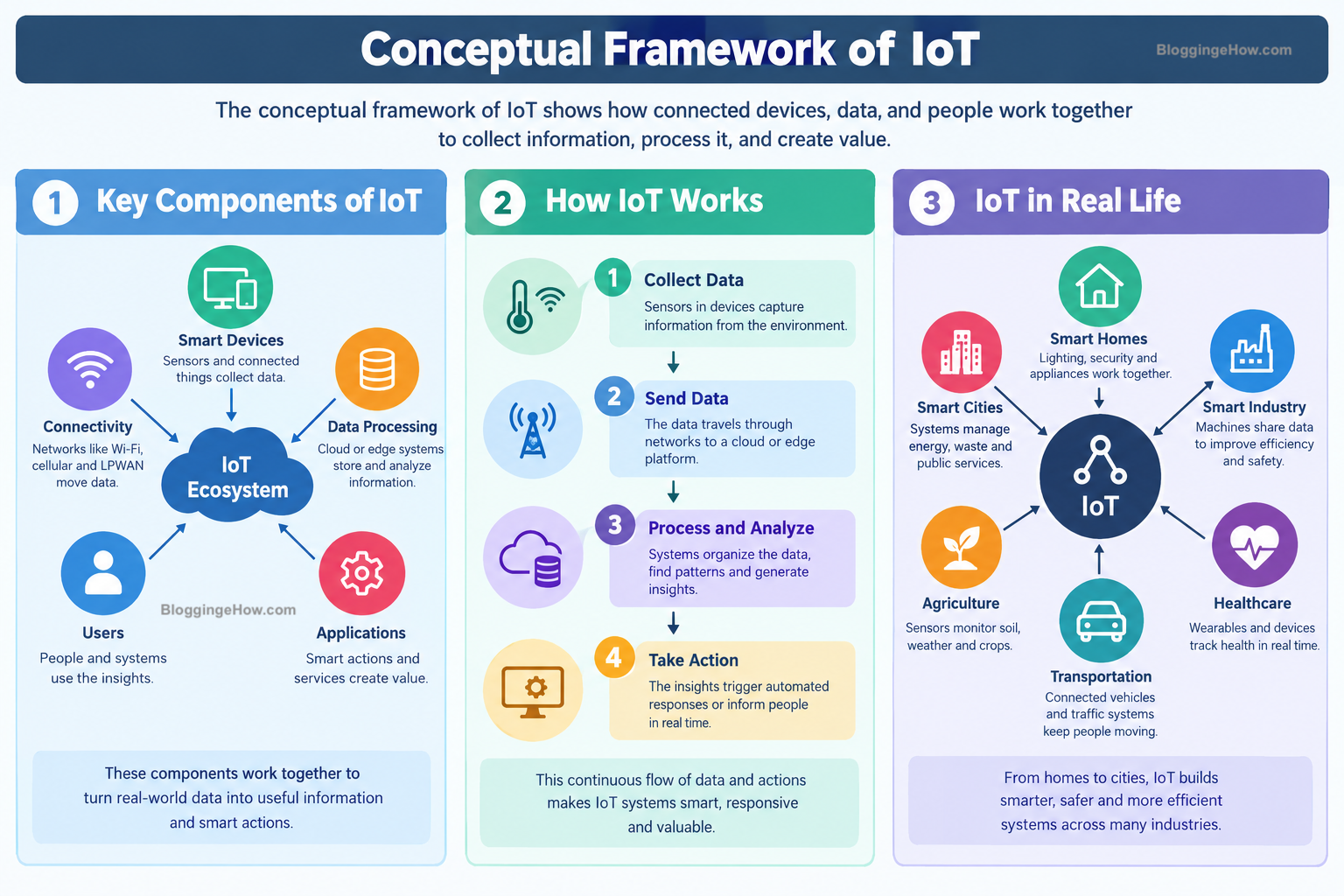
At its simplest, an IoT system contains five kinds of building blocks:
Security, device management, data governance, and operational controls run across all of them.
Think about a smart irrigation system.
A soil moisture sensor measures the field. A wireless connection sends that reading to a gateway. Edge or cloud software evaluates the measurement. An application determines whether irrigation is needed. A controller activates a water pump. The result is another physical change in the environment, which the sensors measure again.
That creates a continuous IoT feedback loop:
Sense → Connect → Process → Decide → Act → Sense again
The feedback loop is one of the most useful ways to understand IoT because it explains why IoT is more than a collection of connected gadgets.
The three-layer architecture is the classic introductory model for IoT. Research literature describes it using three layers: perception, network, and application.
The perception layer is the physical side of IoT.
It interacts with the real world through:
The term perception refers to the system’s ability to observe physical conditions and gather information.
Suppose you install sensors on a factory motor. The motor itself is a physical asset, but sensors can measure vibration, temperature, speed, electrical current, or pressure.
The sensor converts a physical phenomenon into digital information that the IoT system can use.
Actuators perform the reverse kind of job. They receive commands and create a physical effect. A valve can open, a motor can stop, a light can switch on, or a robotic mechanism can move.
The network layer transports information between devices and other parts of the system.
Depending on the use case, connectivity can involve:
The network layer is not simply “the internet.” IoT deployments frequently combine local networks, gateways, cellular links, enterprise networks, and cloud connections.
For example, a smart electricity meter may communicate locally with a gateway before information reaches a utility’s backend platform.
The application layer turns processed IoT data into something useful to people, organizations, or automated systems.
Applications can include:
A three-layer model is easy to understand, yet it hides a large amount of work between the network and the final application. Data may need filtering, storage, normalization, aggregation, analysis, authentication, and business processing before an application can use it.
That is why more detailed IoT models exist.
The five-layer model expands the basic architecture by separating transport, processing, and business functions.
The commonly described layers are:
Academic literature describes the five-layer architecture as an extension of the earlier three-layer model, adding processing and business functions to represent IoT systems in greater detail.
This remains the physical sensing and actuation layer.
Devices collect information from their surroundings and interact with physical systems.
The transport layer carries information from devices toward processing systems and can also carry commands back toward devices.
It may involve wireless networks, wired networks, gateways, cellular connectivity, Bluetooth, and other communication technologies.
A useful distinction is:
Perception asks, “What is happening physically?”
Transport asks, “How does the information get from one place to another?”
This is where raw IoT data becomes usable information.
The processing layer can perform:
Modern deployments can divide this work between edge computing and cloud computing.
An industrial gateway might detect an abnormal vibration locally and trigger an immediate alert. A cloud platform may store months of vibration history and run larger analytical jobs across thousands of machines.
The two approaches can work together.
The application layer uses the processed information to deliver an IoT service.
A predictive maintenance application could display machine health, abnormal vibration, maintenance schedules, and alerts.
A smart agriculture application could combine soil moisture, weather information, irrigation status, and crop data.
The business layer connects IoT technology to organizational goals and processes.
A factory does not deploy sensors simply because collecting millions of temperature readings is interesting. It might use sensors to reduce machine downtime, improve production quality, lower energy consumption, or improve worker safety.
The business layer can include:
This is where IoT becomes an operational system rather than just a technical project.
For technical discussions, the IoT World Forum reference model provides a more granular seven-layer view.
The model breaks IoT into:
| Layer | Main function | Typical examples |
|---|---|---|
| 1. Physical Devices and Controllers | Sense and control the physical world | Sensors, machines, actuators |
| 2. Connectivity | Move data and commands | Wi-Fi, Ethernet, cellular, gateways |
| 3. Edge Computing | Analyze and prepare data near its source | Edge gateways, local analytics |
| 4. Data Accumulation | Store incoming data | Databases, data storage systems |
| 5. Data Abstraction | Organize, integrate, and expose data | APIs, normalization, data integration |
| 6. Application | Analyze and use the data | Dashboards, analytics, control software |
| 7. Collaboration and Processes | Connect information to people and workflows | Operations, decisions, business processes |
The seven-layer model was developed to provide a common framework for understanding IoT information flow and to separate technical responsibilities into smaller parts. A published reference description identifies these seven levels from physical devices and controllers at Layer 1 through collaboration and processes at Layer 7.
This is the “things” part of the Internet of Things.
Devices may include sensors, actuators, embedded controllers, cameras, machines, vehicles, appliances, medical devices, and industrial equipment.
A device does not necessarily have to be a fully independent computer. Many IoT endpoints are small embedded systems with limited processor power, memory, energy, and connectivity.
Connectivity moves information between physical devices, gateways, edge infrastructure, and higher layers.
This layer must deal with issues such as:
Different IoT applications have different communication needs.
A battery-powered environmental sensor may send tiny packets occasionally. A security camera requires a much larger and more continuous data stream.
Edge computing moves some computation closer to where data is generated.
This can reduce latency and limit the amount of information that needs to travel to centralized systems.
Imagine 10,000 factory sensors generating readings every second.
Sending every raw reading directly to a remote cloud service may be unnecessary. An edge system can identify abnormal patterns locally, discard irrelevant data, aggregate measurements, and send useful events upstream.
Edge computing can also support local operation when cloud connectivity is interrupted.
IoT systems often generate continuous streams of information.
Data accumulation is the point where those streams can be captured and stored for later use.
This may involve:
The distinction matters because data arriving continuously is different from data that an application wants to query later.
Different devices rarely produce data in exactly the same format.
One manufacturer may report temperature in Celsius. Another may use Fahrenheit. One device may identify a machine with a serial number, another with a different identifier.
The data abstraction layer helps make information accessible in a consistent form.
It can deal with:
This is one reason interoperability remains a recurring issue in IoT.
ETSI’s SAREF initiative, for example, provides a shared ontology intended to support semantic interoperability among smart applications, providers, and activity sectors.
This is where software turns information into useful functionality.
Examples include:
A fleet management platform tracking vehicles.
A hospital system monitoring connected equipment.
A factory application detecting abnormal equipment conditions.
A building management system adjusting heating and cooling.
The top layer connects technology with people and operational processes.
Consider a factory alert stating that a motor has developed an abnormal vibration pattern.
The application can display the warning, but the system only creates operational value when somebody or something responds.
A maintenance workflow might:
That is the difference between data availability and operational use.
You may see IoT architecture described as having three, four, five, six, or seven layers.
That does not mean one diagram is automatically correct and another is wrong.
The difference usually comes from how much detail the model wants to expose.
The three-layer model compresses several technical functions into broad categories.
The five-layer model separates processing and business responsibilities.
The seven-layer IoT World Forum model separates edge computing, data accumulation, data abstraction, applications, and collaboration.
ITU’s reference model uses four primary functional layers and treats management and security as cross-layer capabilities.
A useful way to think about them is:
3 layers = simple conceptual explanation
5 layers = greater functional separation
7 layers = detailed technical data flow
Formal standards = architecture guidance for designing real systems across multiple viewpoints
The models can describe the same IoT deployment without requiring every deployment to implement physically separated components for every layer.
People searching for a “conceptual framework of IoT” can easily end up mixing academic layer diagrams with formal architecture standards.
ISO/IEC 30141 is useful for understanding the difference.
The current published standard, ISO/IEC 30141:2024, establishes a standardized IoT reference architecture using common vocabulary, reusable designs, and industry practices. ISO says its approach begins by identifying important characteristics of IoT, creating a foundational view, then providing additional architecture views for system construction and design.
That approach is broader than simply drawing boxes labeled “sensor,” “network,” and “cloud.”
A real IoT deployment may involve:
Architects need to understand how these pieces interact, not merely which layer a device belongs to.
For a practical system, we can simplify the architecture into six connected stages:
1. Physical world
Machines, buildings, vehicles, farms, people, utilities, appliances, or other assets.
2. Sensing and actuation
Sensors capture conditions. Actuators perform actions.
3. Connectivity and gateways
Data is transported across local networks, wireless technologies, gateways, cellular systems, or IP networks.
4. Edge and cloud processing
Data can be filtered, analyzed, transformed, stored, and evaluated locally or remotely.
5. Applications and services
Software presents information, detects events, performs analytics, and controls connected assets.
6. People and business processes
Operators, customers, technicians, managers, automated workflows, and organizations respond to the information.
Security and management sit across all six.
This representation is often easier to use in a real project because it connects technical architecture with actual operations.
Consider a smart cold-storage warehouse.
A temperature sensor reports:
2.8°C
The connectivity system transports that reading to an edge gateway.
The gateway checks the reading and compares it with predefined thresholds.
If the temperature remains normal, the data can be stored for historical analysis.
If the temperature rises above a configured threshold, the edge system may immediately issue an alert.
The cloud platform can then store the event, correlate it with previous readings, and update a dashboard.
A manager receives an alert.
A maintenance system creates a service request.
A technician checks the refrigeration equipment.
The technician records the result.
The IoT system starts collecting new measurements.
The entire chain can be represented as:
Sensor → Gateway → Edge processing → Network → Storage → Analytics → Application → Human action → Actuator or operational response
That is the conceptual framework in action.
One of the biggest changes in modern IoT architecture is the increased use of edge computing.
Traditional diagrams often make the cloud look like the central brain of every IoT system.
Real systems can distribute computation.
A sensor or embedded controller may perform simple calculations directly.
A gateway or local server can filter and analyze data close to the device.
Large-scale systems can perform long-term storage, cross-device analytics, machine learning, reporting, and centralized management.
This gives architects a design choice.
A safety-critical industrial system may need local decision-making because waiting for a remote service could introduce unacceptable latency.
A consumer smart-home application may rely heavily on cloud services because the workload is less time-sensitive.
AWS’s current IoT security guidance explicitly addresses edge locations, gateways, network segmentation, secure connectivity, local processing, device updates, and cloud integration in industrial IoT environments.
Security should not be treated as something added at the application after the IoT architecture has been built.
An IoT system can be attacked at many points:
NIST’s IoT device cybersecurity baseline identifies technical capabilities including device identification, device configuration, data protection, logical access to interfaces, software updates, cybersecurity state awareness, and device security.
NIST also separates technical device capabilities from non-technical supporting capabilities that manufacturers and third parties provide across the device lifecycle.
That means an IoT conceptual framework needs to account for more than encryption.
A secure deployment may require:
Unique device identity → authentication → authorization → protected communication → secure updates → monitoring → logging → incident response
AWS’s current IoT security reference architecture also recommends device identity lifecycle management, secure protocols, network segmentation, encryption, data governance, monitoring, and incident response.
Managing thousands of devices manually is not practical.
An IoT platform may need to know:
Device management can continue throughout the device lifecycle:
Provisioning → configuration → operation → monitoring → update → credential rotation → retirement
This is especially relevant in industrial deployments where connected equipment may remain in service for many years.
NIST’s IoT guidance treats cybersecurity as part of product development and lifecycle support rather than a task that begins after deployment.
A smart home might contain motion sensors, cameras, thermostats, lighting controllers, locks, speakers, and appliances.
The framework is relatively easy to visualize:
Sensors → home network → gateway or cloud → mobile application → user command → device
The main concerns often include privacy, device identity, reliability, interoperability, and consumer security.
A farm may use:
IoT connects physical measurements to decisions about irrigation, fertilization, equipment, and environmental conditions.
Edge processing can be useful in locations where internet connectivity is limited.
Industrial IoT, often called IIoT, introduces machines, production systems, controllers, sensors, industrial gateways, and operational technology.
The architecture may need to operate with legacy systems and strict availability requirements.
AWS describes IIoT and operational technology deployments as having distinctive considerations involving real-time operations, safety-critical systems, legacy protocols, network segmentation, and IT and OT integration.
A smart-city system may connect:
At this scale, interoperability and governance become especially relevant because different departments, organizations, and vendors may operate different systems.
Connected healthcare systems can involve wearable sensors, monitoring equipment, medical devices, hospital infrastructure, and software platforms.
Data handling becomes particularly sensitive because IoT systems may process information associated with individuals and clinical operations.
The architectural principle remains the same:
Sense → communicate → process → interpret → respond
The security and governance requirements become more demanding.
Different layers can use different communication technologies and protocols.
Common technologies include:
At the device and local network level: Bluetooth, Zigbee, RFID, NFC, Wi-Fi, Ethernet.
At the Internet and transport level: IP networks, IPv6, cellular connectivity.
At the application messaging level: MQTT, HTTP, CoAP, and other protocols.
The appropriate choice depends on factors such as:
OneM2M provides another architectural perspective. Its functional architecture uses a horizontal three-layer approach involving applications, middleware services, and networks, with common service functions such as device management, registration, security, data handling, discovery, and location services.
That distinction is useful because an IoT architecture does not have to be organized strictly as a stack of isolated layers.
This is one of the biggest misunderstandings around IoT.
A sensor can collect data without creating a useful IoT service.
A connected machine can send information without anyone using it.
A cloud database can store billions of measurements without changing an operational process.
The value of the IoT framework comes from connecting the full chain.
For example:
Sensor
Measures vibration.
Connectivity
Transmits the reading.
Edge processing
Filters noise and detects unusual patterns.
Data storage
Maintains historical information.
Data abstraction
Makes information consistent and accessible.
Application
Shows machine health.
Business process
Schedules maintenance.
Actuator or operator
Responds to the condition.
That is an actual closed operational system.
When you build an IoT system, start with the physical problem rather than choosing hardware first.
Ask what physical conditions matter.
Is it temperature, pressure, location, vibration, movement, humidity, energy use, occupancy, or another variable?
An IoT system becomes much more useful when measurement leads to a decision or action.
Could the system:
Choose sensors, controllers, actuators, power systems, and enclosures according to the real environment.
Consider distance, power consumption, bandwidth, reliability, interference, and network availability.
Some information may need instant local processing.
Other information can be processed centrally.
Many practical systems use both edge and cloud computing.
Determine what each measurement means, how devices are identified, how timestamps are handled, and how different sources will be combined.
Create dashboards, alerts, reports, APIs, automation, analytics, or control interfaces according to the actual use case.
Define who receives an alert, who acts on it, what happens after an event, and how the result gets recorded.
Plan identity, authentication, authorization, encryption, updates, monitoring, logging, device retirement, and data protection before deployment.
NIST and AWS guidance both support treating device security and lifecycle controls as core parts of IoT system design.
You can remember the architecture like this:
PHYSICAL WORLD
Machines, people, buildings, vehicles, appliances, environment
↓
SENSING & ACTUATION
Sensors, controllers, actuators
↓
CONNECTIVITY
Wi-Fi, Ethernet, Bluetooth, cellular, gateways, IP networks
↓
EDGE COMPUTING
Filtering, local analytics, protocol conversion, event detection
↓
DATA MANAGEMENT
Storage, integration, normalization, APIs, data models
↓
APPLICATIONS
Dashboards, analytics, alerts, automation, monitoring
↓
PEOPLE & PROCESSES
Operators, customers, maintenance teams, business workflows
↓
PHYSICAL ACTION
Machines, valves, lights, vehicles, equipment, infrastructure
SECURITY + DEVICE MANAGEMENT + GOVERNANCE
operate across the entire framework.
This captures the common ideas found across the major IoT architecture models without pretending that every deployment has identical components.
The terms are often used interchangeably, but there is a useful distinction.
An IoT conceptual framework explains the major concepts and relationships.
An IoT reference architecture provides a more structured architectural model that can guide system design.
An actual IoT architecture is the implementation chosen for a particular project.
For example:
Conceptual framework:
Sensors → connectivity → processing → applications.
Reference architecture:
A defined set of layers, functions, interfaces, responsibilities, and architecture views.
Actual implementation:
Temperature sensors + LoRaWAN gateway + edge server + MQTT broker + time-series database + analytics service + mobile application.
The first explains the idea. The second establishes an architectural structure. The third builds the working system.
A good framework helps teams divide a complicated IoT project into manageable responsibilities.
A hardware engineer can focus on sensors and controllers.
A network engineer can design connectivity.
An edge engineer can handle local processing.
A data engineer can build storage and integration.
A software team can build applications.
Security teams can apply controls across the architecture.
Operations teams can connect the resulting information to real processes.
This separation also makes troubleshooting easier.
If a temperature reading never reaches the application, you can investigate the chain:
Sensor → connectivity → gateway → edge processing → storage → data service → application
Rather than treating “the IoT system” as one mysterious box, the framework gives every stage a defined role.
The conceptual framework of IoT is a structured representation of how connected physical things collect data, communicate it, process it, store and integrate it, expose it through applications, and connect it to people or automated processes.
The classic three-layer model consists of the perception layer, network layer, and application layer.
The five-layer model generally consists of perception, transport, processing, application, and business layers.
The IoT World Forum reference model uses physical devices and controllers, connectivity, edge computing, data accumulation, data abstraction, application, and collaboration and processes.
No single layered architecture is used for every IoT system. Academic and industry models use different abstractions, and formal references such as ITU-T Y.4000/Y.2060 and ISO/IEC 30141 provide broader architecture frameworks.
Edge computing performs some processing near the source of the data. This can reduce latency, reduce unnecessary data transmission, support local decisions, and help systems continue operating when cloud connectivity is limited.
No. An IoT deployment can use local processing, edge computing, cloud computing, or a combination of them. The appropriate architecture depends on the workload, connectivity, latency, security, cost, and operational requirements.
A vulnerability in a device, gateway, network, application, credential system, or update process can affect the wider IoT ecosystem. NIST’s IoT cybersecurity baseline and current industry security architectures both treat device identity, access, data protection, software updates, monitoring, and other controls as parts of the broader system.
IoT is easiest to understand when you stop viewing it as “devices connected to the internet” and start viewing it as a continuous information and control system.
Physical things produce signals. Connectivity moves them. Computing turns signals into useful information. Data systems preserve and organize that information. Applications interpret it. People and automated processes act on it. Those actions affect the physical world again.
The three-layer model gives you the basic map. The five-layer model explains the internal processing. The seven-layer model gives you a more detailed technical path from devices to business processes. ITU and ISO frameworks provide more formal ways of describing complete IoT systems.
Once those relationships are understood, an IoT system stops looking like a collection of sensors and starts looking like what it really is: a connected cyber-physical system that continuously turns real-world conditions into data, decisions, and actions.